This Website is not fully compatible with Internet Explorer.
For a more complete and secure browsing experience please consider using Microsoft Edge, Firefox, or Chrome
Data-driven benchmark - Industry Challenge Problem
t
Inspired by strategic discussions within the ASSESS Initiative, NAFEMS are challenging simulation vendors with a geometric deep learning in order to understand the maturity of machine learning in the engineering simulation sector. The data for the challenge problem has been provided by Piaggio and NAFEMS would like to extend their gratitude to Riccardo Testi for his support with this initiative.
The Challenge
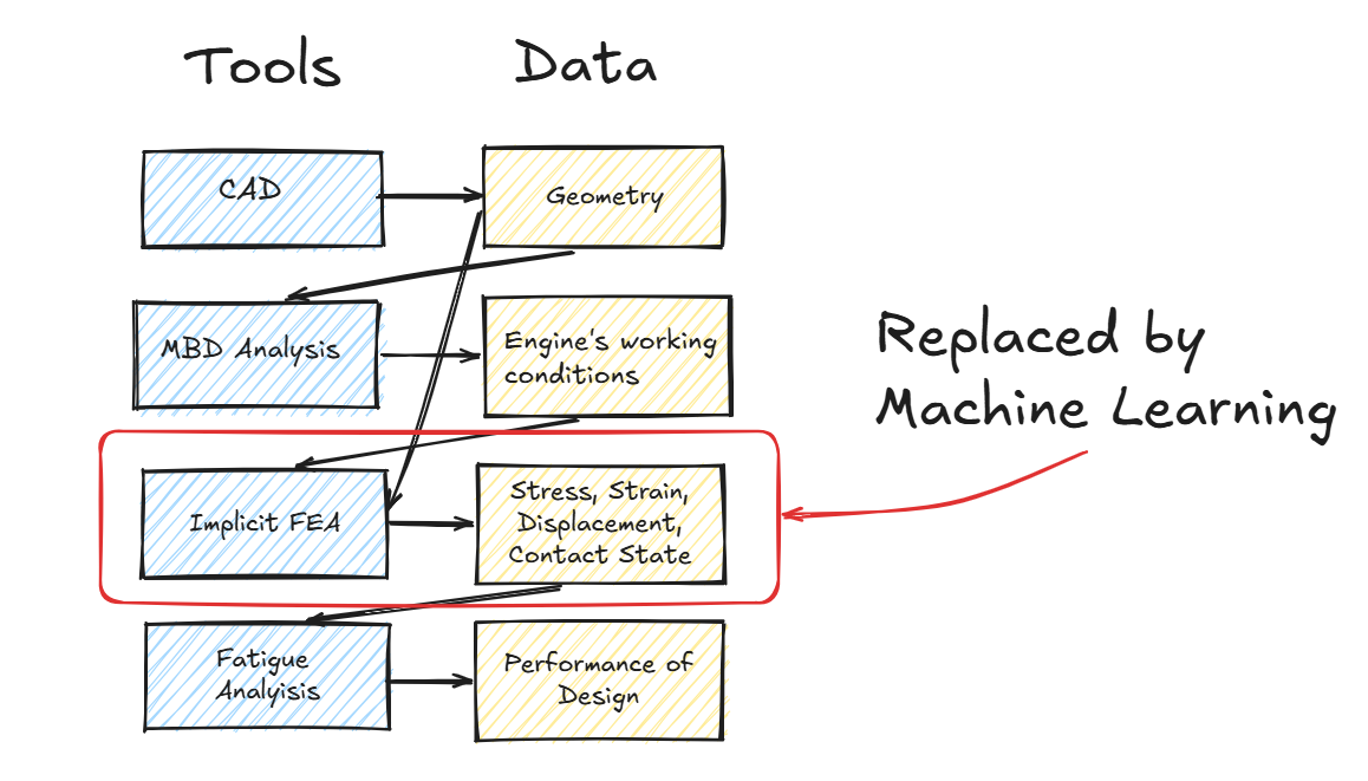
A typical virtual design process for a conrod is shown in Figure1. For each conrod variant an MBD analysis is run to simulate a specific operating condition e.g. max torque. Bearing loads, inertia loads and velocity are extracted at regular intervals as the conrod proceeds through its cycle. These loads are used as loads in an implicit FEA. Once the Implicit FEA is solved, the results are fed into a durability analysis and the performance of the conrod is assessed.
Due to the size of models and number of load cases running the implicit FEA is a computational expensive and time consuming process. The challenge is to train a Machine Learning model to replace the implicit FEA step in the design process.
The Dataset
The dataset used for training consists of FEA output from historical conrod design studies. The output is provided in the original format used by Piaggio (ANSYS rst files. To maintain NAFEMS' commitment to vendor neutrality, the results are provided in the open standard VMAP format
IText files have also been provided which detail the load conditions that were applied at each increment.
Accessing the Dataset
Responses
Dates, what are we looking for
curated finite element analysis dataset builds upon NAFEMS' 40-year legacy of establishing trusted industry benchmarks for physics-based simulation and looks to the emerging use of AI in engineering simulation.
The collection provides baseline data on principal stress distributions within plate geometries. A deliberately simple problem was selected to maximise the dataset's educational merit. Because the peak principal stress for this geometry can be validated against a well-established analytical solution (Heywood's equations), the dataset provides a transparent baseline. This simplicity allows engineers and researchers to study fundamental behaviour of the data driven models, such as demonstrating how the quantity and distribution of training data impacts the model predictions. As artificial intelligence models increasingly integrate into commercial simulation tools, this dataset is intended to serve as a useful resource for engineers looking for a vendor neutral dataset.