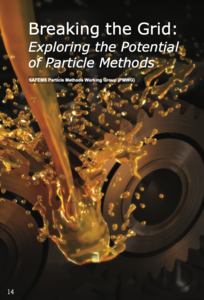
Particle methods are a powerful class of numerical techniques that simulate engineering systems by representing the computational domain as a collection of interacting particles. Unlike conventional mesh-based methods where element connectivity is fixed, particle methods dynamically adapt. This makes them uniquely suited to model complex, highly dynamic phenomena that traditionally challenge grid-based solvers.
Recognising the growing importance of these techniques in modern simulation, the NAFEMS Particle Methods Working Group (PMWG) was established. Their goal is to support education, promote best practices, and facilitate open collaboration among industry professionals, academia, and software developers. The group specifically focuses on application-ready commercial and open-source software suitable for industrial product development.
A major advantage of particle methods is their versatility in addressing highly complex engineering questions across both fluid and solid mechanics. In fluid dynamics, these methods natively excel at modelling free-surface flows, splashing, multi-phase interactions, and complex fluid-structure interactions. In the solid mechanics domain, explicit particle methods provide robust solutions for systems undergoing extreme nonlinear deformation, rupture, and material separation where traditional meshes would fail or become excessively distorted.
To illustrate these capabilities in practice, the PMWG has compiled a collection of short ‘one-page’ case studies showcasing key application areas:
- Vehicle Water Wading and Water Ingress: Simulating external water management, vehicle splashing, and sealing performance under dynamic conditions.
- IPX5 Water Jet Simulation: Modelling high-pressure water nozzle spray dynamics for component ingress protection testing.
- Gearbox Lubrication: Analysing multiphase fluid sloshing, oil distribution, and internal component wetting in powertrain systems.
- High-Energy Impacts and Bird Strike: Simulating extreme structural impact, severe structural deformation, and energy absorption in aerospace components.
By breaking the constraints of the traditional mesh, particle methods empower simulation engineers to explore new frontiers in predictive design. We invite you to explore the following case studies and discover how particle-based techniques can complement and elevate your engineering workflows.
This article appeared in the October 2026 Issue of BENCHMARK.